


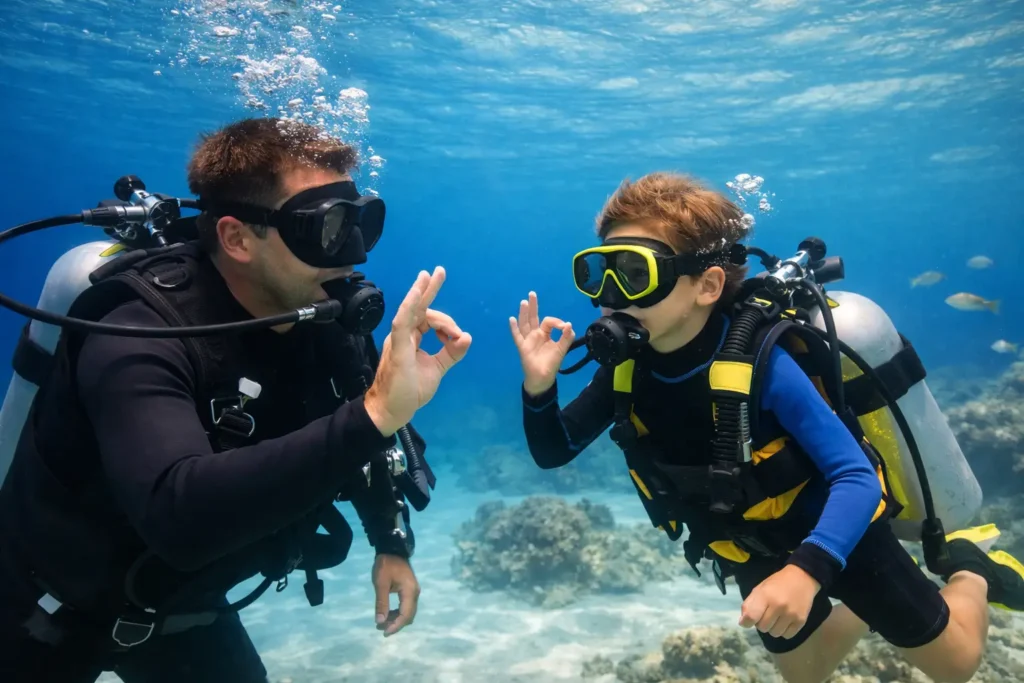
One of the first questions parents ask before booking a family dive day is simple: what age can kids scuba? The short answer is 8 for a supervised introductory pool-style experience with some training agencies, and 10 for junior certification in open water. The better answer is that age is only the starting point. A child can meet the minimum age on paper and still not be ready for a real underwater experience.
That matters because scuba is not like putting on a snorkel and kicking around the shallows. It asks a child to listen carefully, stay calm, equalize their ears, follow directions in sequence, and respond well if something feels unfamiliar. For some kids, that clicks right away. For others, waiting a year makes the entire experience safer and far more enjoyable.
What age can kids scuba with formal training?
Most major training agencies allow children to start earlier than many parents expect, but with different limits depending on the program.
At age 8, kids can usually try a closely supervised introductory scuba experience in confined water. That often means a pool or very calm, shallow water with an instructor right beside them. It is not the same as being certified to go on standard open water dives.
At age 10, many kids can begin a junior open water certification. That certification comes with restrictions, usually around depth and required supervision by a certified adult or professional. As they get older, those limits change.
By age 12, children may qualify for more junior-level continuing education. By age 15, junior ratings often convert to the standard adult certification level, assuming course requirements are met.
So if you are asking what age can kids scuba, the official answer is often 8 to start and 10 to certify. If you are asking when they should scuba, that takes a more honest look at the child in front of you.
Age minimums are not the same as readiness
This is where good dive operators separate themselves from the crowd. A responsible instructor does not treat every 10-year-old the same just because the paperwork says they can enroll.
Some kids are natural listeners, comfortable in the water, and steady under pressure. Others are athletic and fearless but struggle to slow down and follow instructions. In scuba, the calmer child often does better than the bold one.
Real readiness usually comes down to a few things. Can your child swim comfortably without panic? Can they focus for a full briefing? Will they tell an adult when something feels wrong, or do they tend to hide discomfort? Can they handle small moments of frustration without melting down?
A child also needs enough physical awareness to manage basic gear, clear a mask, recover a regulator, and equalize early and often. None of these skills are extreme, but they do require composure. Underwater, that matters more than confidence at the hotel pool.
The biggest safety factors for kids in scuba
Parents often focus on depth, and that is reasonable, but depth is only one part of the picture. Supervision, conditions, and pacing matter just as much.
The safest kids’ scuba experiences happen in calm, warm water with excellent visibility, gentle entries, and very low student-to-instructor ratios. That gives the child mental space to enjoy the experience instead of spending all their energy coping with waves, cold, current, or a rushed group.
Ear equalization is one of the biggest issues for children. If a child cannot equalize comfortably, the dive should stop. No pushing through it. A good instructor will descend slowly, check constantly, and make it clear that calling the dive is completely fine.
Attention span is another factor people underestimate. Kids can be excited during the first ten minutes, then get mentally overloaded fast. That is why shorter, simpler dives tend to be better than trying to pack too much into one session.
Gear fit matters too. Adult gear scaled down badly is not good enough. A child should be able to move, breathe comfortably, and avoid being overwhelmed by a bulky setup. When equipment fits properly, everything feels easier.
Intro experience or certification – which is better?
For many families, an introductory experience is the smarter first step.
If your child is curious but untested, a shallow, instructor-led try scuba session lets them feel the gear, breathe underwater, and see how they react without the pressure of a full course. That first experience answers a lot of questions quickly. Some kids come up beaming and want more. Others decide they prefer snorkeling, and that is perfectly fine.
Certification makes more sense when a child already loves the water, follows direction well, and genuinely wants to learn the full set of scuba skills. It should not be a vacation checkbox forced by enthusiastic parents.
There is also a practical side. Family travel days are often packed. If your child is tired, overstimulated, sunburned, or running on little sleep, a certification course may feel like work rather than adventure. The intro route keeps the bar lower and the experience lighter.
What parents should ask before booking
If you are comparing dive centers, ask better questions than just age minimums.
Ask about instructor-to-student ratios for kids. Ask whether the first session is in confined water or directly in open water. Ask how they handle nervous children, ear equalization issues, and kids who decide they do not want to continue. Ask whether the equipment is truly kid-sized and whether the staff regularly teaches young divers.
You should also ask about conditions, not just the program. Warm, clear, calm water changes everything for beginners. In a place like Bayahibe, where conditions are often friendly for first-timers, a child has a much better chance of focusing on the fun part instead of fighting the environment.
The best operators are not trying to push every child underwater at all costs. They are willing to slow down, adapt the plan, or say, this is not the right day. That is exactly the kind of professionalism parents should want.
Signs your child is ready
There is no perfect checklist, but a few patterns are encouraging.
A ready child usually enjoys being in the water without clinging to an adult the whole time. They can listen through a short safety talk and repeat simple instructions back. They are curious about the ocean rather than scared of every unknown. If they get uncomfortable, they communicate instead of freezing.
It also helps if the child wants to scuba for their own reasons. Maybe they love fish, shipwreck stories, or the idea of breathing underwater. Motivation matters. Kids who feel ownership tend to cooperate better and remember more.
One more sign is patience. Scuba has little routines that cannot be skipped. Mask on, regulator in, breathe slowly, signal clearly, descend gradually. A child who can respect that rhythm is usually in a stronger position than one who wants to charge ahead.
Signs it is better to wait
Sometimes the best decision is not yet.
If your child panics easily in water, refuses to put their face in, struggles with basic swimming confidence, or gets frustrated the moment something feels unfamiliar, waiting is usually wiser than pushing through. The same goes for kids who will not speak up when something hurts or feels wrong.
Children who are desperate to please adults can also be tricky. They may say they are okay when they are not. That is why experienced instructors watch body language closely. A quiet child is not always a comfortable child.
Waiting is not missing out. In many cases, one extra year turns a stressful first attempt into a fantastic one.
What age can kids scuba and actually enjoy it?
If we move away from minimum standards and talk about enjoyment, many kids hit the sweet spot around 10 to 12. By then, they are often better at listening, equalizing, swimming with control, and understanding the difference between excitement and safety.
That does not mean younger children cannot have a great first experience. Plenty do. But the younger the child, the more the quality of the operator, the conditions, and the pace of the session matter.
For families on vacation, the best outcome is not simply getting the child underwater. It is helping them finish the experience feeling proud, safe, and eager to do it again. That is how lifelong divers begin.
At Diving DR, we have seen it firsthand – when a child is introduced to scuba the right way, in the right conditions, with patient instructors and no pressure, the moment becomes bigger than a vacation activity. It becomes a core memory.
If your child is close to the minimum age, think beyond the number. Look at their confidence, curiosity, and ability to stay calm. The right time for kids to scuba is when safety and excitement line up together, because that is when the ocean starts to feel like a place they can truly enjoy.
