


The first sign of a great day on the water is often a quiet one: the boat has left the marina early, the surface is still glassy, and the reef is not yet busy with other groups. The top Bayahibe marine life encounters are not staged attractions. They happen when clear Caribbean water, the right site, and an unhurried crew come together – which is exactly why an early, small-group day can feel completely different from a standard crowded excursion.
Bayahibe sits beside some of the Dominican Republic’s most productive coastal habitats, with reef systems, sandy bottoms, seagrass areas, walls, and access toward Saona Island and Parque Nacional del Este. That variety gives snorkelers and divers a real chance to see more than pretty coral and a few fish. It also means wildlife sightings are never something a responsible operator should promise. Nature keeps its own schedule. What local knowledge can do is put you in the right water, at the right time, with enough flexibility to enjoy what appears.
Top Bayahibe Marine Life Encounters to Look For
Sea turtles in the shallows and on the reef
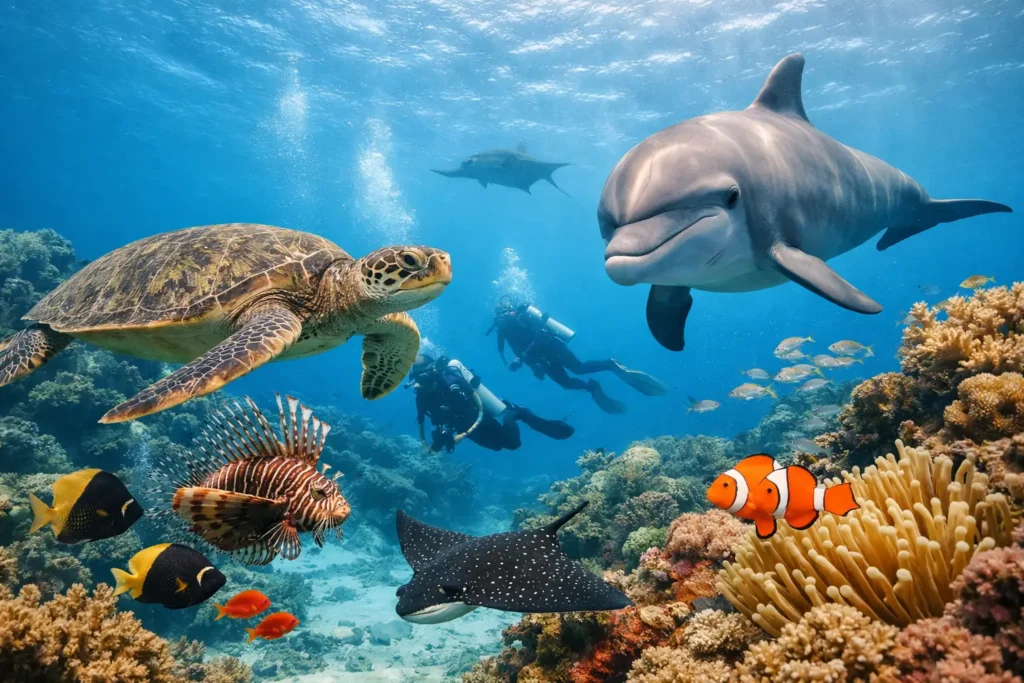
Seeing a sea turtle glide past while you are suspended over a reef is one of those moments that quiets an entire group. Green turtles and hawksbill turtles may be seen around local reef and seagrass environments, sometimes feeding calmly, sometimes passing through with astonishing speed.
For snorkelers, the best turtle encounter is usually not about chasing a sighting. It is about floating quietly in suitable shallow water, keeping your arms close, and letting the animal choose its distance. Divers may find turtles resting around reef structures or moving between feeding areas. Either way, stay well back, never block its path to the surface, and do not touch the shell. A turtle that continues feeding or swimming naturally is the sign that you are watching it correctly.
Southern stingrays and eagle rays over the sand
The sandy channels between reef sections can be just as exciting as the coral itself. Southern stingrays often blend into the bottom so well that guests first notice the outline, then the graceful movement of the wings as the ray lifts off the sand. They are generally calm animals, but they deserve space. Hover above rather than dropping down beside them, and never attempt to approach from directly overhead.
Eagle rays are less predictable and often more dramatic. Their spotted bodies and wide, powerful wings make even a brief appearance memorable. They may cruise past a reef edge or cross open water in small groups. A sighting can happen in seconds, so certified divers should keep good buoyancy and remain aware of the blue water beyond the reef, not just what is directly below.
Colorful reef fish that reward a slower look
Parrotfish, blue tangs, French angelfish, sergeant majors, trumpetfish, squirrelfish, and schools of grunts provide the constant motion that makes Caribbean reefs feel alive. First-time visitors sometimes focus only on the largest animals, then realize that the most interesting scenes are happening within a few feet of the coral.
Watch a parrotfish work across the reef and you are seeing a crucial part of the ecosystem. Listen closely underwater and, on a calm day, you may even hear the crunch of fish feeding on algae-covered coral. Look into a ledge and a shy lobster may be tucked inside. Pause near a sponge or sea fan, and a tiny juvenile fish can suddenly become visible. This is where a good guide earns their place: the reef becomes far richer when someone knows where to slow down.
Moray eels, lobsters, and the reef’s hidden residents
Moray eels have a reputation that is much scarier than their usual behavior. Their open-and-close mouth movement is normally how they breathe, not a warning that they plan to attack. Guests may spot spotted morays or green morays peering from crevices, especially on dives where the group moves slowly and avoids waving hands into holes.
Lobsters, crabs, cleaner shrimp, and other smaller residents are easy to miss during a rushed swim. This is one reason private guides and smaller groups have an advantage. You can take a moment at a reef feature without feeling pushed along by a rigid schedule. For photographers, it also creates the chance to capture a more natural image without crowding an animal or stirring up the bottom.
Barracuda, jacks, and big-water energy
Not every encounter is cute, colorful, or close to the reef. Great barracuda may hang nearly motionless in open water, their silver bodies catching the light as they watch from a distance. They are an impressive sight and usually show little interest in divers who remain calm and avoid shiny objects near the surface.
Schools of jacks bring a different kind of energy. They can move around a reef like a shifting wall of silver, often attracting everyone’s attention at once. When the current is moving, these pelagic visitors may become part of the experience, especially at sites with a drop-off or more open exposure. Conditions matter here. A calm, easy reef may be ideal for a Try Scuba guest, while a more current-prone site is better suited to comfortable certified divers.
Why Site Choice Matters More Than a Species Checklist
There is no single “best” Bayahibe marine life site for every person. A family with young snorkelers may value protected, shallow water where they can spend time watching reef fish and perhaps spot a turtle without managing waves. A newly certified diver may prefer a relaxed reef with simple navigation and long bottom time. An experienced diver may want a deeper profile, a wreck, or a reef edge where larger fish have more room to pass.
That is why the smartest plan begins with your comfort level, not a wish list alone. Tell the crew whether you are snorkeling, trying scuba for the first time, returning to diving after a break, or looking for a more adventurous multi-site day. Mention any animals you would love to see, but stay open to the conditions. Wind direction, visibility, current, and recent sea state all influence the best route.
At Sharky’s Crew, this kind of flexibility is part of the value of a private or small-group outing. With experienced captains who know the local water and early departures that get ahead of the crowds, the day can be shaped around the guests, the weather, and the sites that are performing best.
Timing Your Encounter Without Chasing It
Caribbean water temperatures are inviting for much of the year, but the daily rhythm matters as much as the season. Early departures commonly mean calmer water, clearer light near the surface, and fewer boats at popular stops. For wildlife, less commotion can make a substantial difference to the quality of the experience, even if it does not guarantee a specific sighting.
Visibility can vary with weather and water movement. On a crystal-clear day, you may see a ray or turtle long before it reaches the reef. On a day with more suspended particles, the reef can still be beautiful, but your guide may favor sites where the structure is close and protected. This is not a lesser day – it is simply a different style of marine encounter.
If your priority is photography, ask for realistic advice before leaving the dock. Wide-angle scenes work well for turtles, rays, and schooling fish, while a compact camera or macro setting can make tiny shrimp and reef details more rewarding. Flash photography and bright video lights should always be used thoughtfully, especially around animals resting in crevices.
Four Rules That Protect the Encounter
Marine life is most extraordinary when it acts naturally. That requires guests to become careful visitors rather than active participants in an animal’s space:
- Keep a respectful distance and let the animal decide whether it comes closer.
- Never touch coral, turtles, rays, fish, or any creature on the reef.
- Control your buoyancy and fins so you do not kick sand or damage living coral.
- Do not feed fish or collect shells, coral, or marine souvenirs.
These basics are not restrictions that take away from the fun. They are what allow a sea turtle to keep feeding, a ray to keep cruising, and a reef to remain worth visiting for the next family, diver, and generation.
Make Room for the Unexpected
The best Bayahibe wildlife day rarely follows a script. You may leave hoping for a turtle and come home talking about a floating school of jacks. You may expect a big-animal encounter and become fascinated by a tiny cleaner shrimp working at a coral station. That is the point of spending real time on the water with people who know it well.
Choose a crew that prioritizes safety, reads conditions honestly, and gives you the breathing room to look rather than rush. Then put your phone away for a few minutes, settle into the blue, and let the Caribbean show you what it has planned.
