


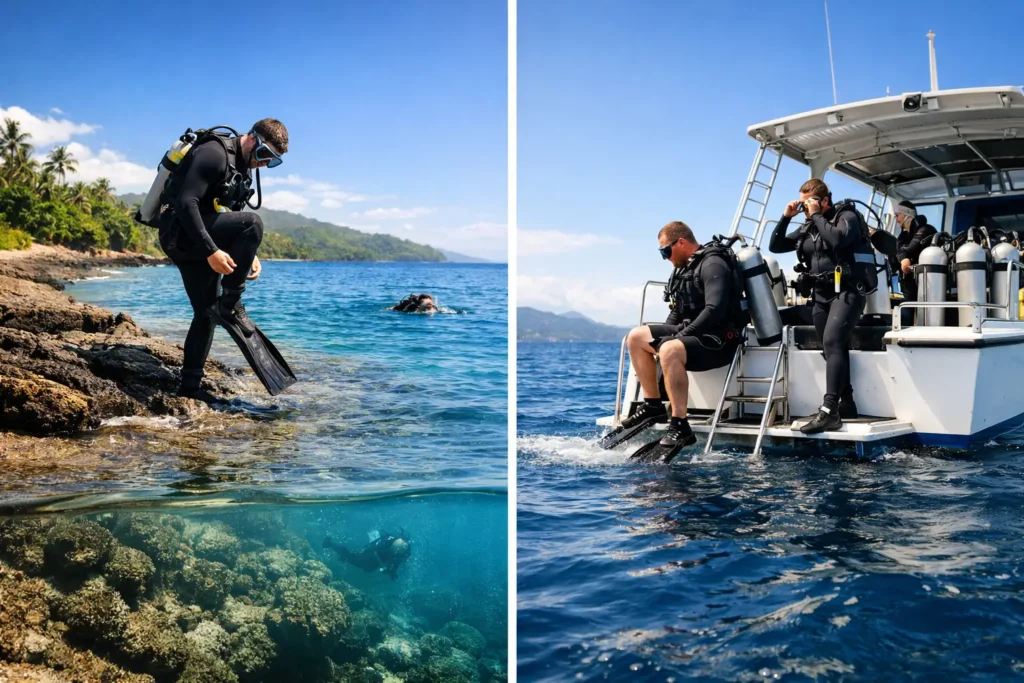
The choice between shore diving vs boat diving can shape your entire day underwater. One puts you in control of the pace, with the beach a few steps away. The other gets you to reefs, wrecks, walls, and quiet corners of the Caribbean that simply cannot be reached from shore. Neither is automatically better. The right choice depends on your certification, confidence, travel plans, and the experience you want to remember.
Shore Diving vs Boat Diving at a Glance
Shore diving starts on land. You carry or wheel your gear to the entry point, walk or wade in, then descend when you are ready. It can feel wonderfully independent, especially for experienced buddies who know the site, understand local conditions, and enjoy setting their own schedule.
Boat diving begins with a ride to the dive site. Your crew handles the route, mooring, surface support, and site briefing, while you conserve your energy for the water. It is often the easiest route to more remote and varied underwater terrain.
The trade-off is straightforward. Shore diving can offer flexibility and a lower-cost feel, but it may involve a long walk, rocky footing, surge at the entry, and more responsibility for navigation. Boat diving requires a set departure time and costs more, but it gives you access, comfort, and local knowledge that can turn a good dive into an exceptional one.
When Shore Diving Makes Sense
Shore diving is appealing because it can be simple. There is no boat schedule to catch, no time spent traveling across the water, and often no pressure to surface at a particular moment. If conditions are calm and the site has an easy sandy entry, a shore dive can be an excellent way to spend a relaxed morning or afternoon.
It also works well for divers who want more time to practice. A newly certified diver may appreciate being able to enter shallow water, check buoyancy, adjust a mask, and move slowly before heading deeper. Underwater photographers often enjoy the unhurried pace, particularly at sites with seagrass, juvenile fish, macro life, or a shallow reef close to shore.
That freedom comes with responsibility. You need to know where to enter and exit, how currents behave, where boat traffic may pass, and what landmarks will help you navigate back. A familiar beach can change after weather, waves, or seasonal sand movement. Even a gentle-looking entry becomes tiring when you are carrying a tank, weights, fins, and camera gear across uneven ground.
For families and travelers trying scuba for the first time, shore diving is not always the easiest option. A long surface swim or a slippery entry can make beginners anxious before they even take their first breath underwater. The best shore dives are easy shore dives, not simply dives that happen to start from a beach.
The real appeal: freedom on your own terms
Experienced divers who have the right local briefing may love the ability to make a long, shallow exploration without watching the clock. Shore diving can also be a smart choice when you have several days in one destination and want to repeat a site under different light, conditions, or tides.
But freedom should never mean guessing. If you are diving somewhere new, ask a local professional about entry conditions, currents, depth changes, marine hazards, and whether the site is appropriate for your experience level.
Why Boat Diving Opens Up More of the Caribbean
A boat is not just transportation. In places where the finest reefs sit offshore, it is your access to the main event. Rather than limiting the day to what is reachable from the sand, you can visit sites selected for the weather, visibility, current, and group skill level.
Around Bayahibe, this matters. The coastline is a gateway to healthy reef systems, wrecks, and marine areas where the water often has the clear blue color people picture when they plan a Dominican Republic diving trip. A knowledgeable captain can choose a protected side of the coast on a breezy day, time a visit around traffic and conditions, and reach reefs before the busier boats arrive.
Boat diving also saves energy. You can set up your equipment aboard, listen to a detailed briefing, and enter close to the site rather than hauling gear across a beach and swimming a long distance. Between dives, you have shade, drinking water, a place to warm up, and a crew keeping an eye on conditions. That support is particularly valuable for beginners, older divers, families, and anyone returning to scuba after time away.
A good boat crew makes the day feel personal rather than rushed. They know which reef has the gentler profile, where schools of fish are likely to gather, and how to help a nervous first-timer feel settled before entry. For certified divers, that same local knowledge can mean a better chance of finding the site that fits your goals, whether that is a dramatic wreck, a colorful shallow reef, or a quieter multi-site day.
The trade-offs to consider
Boat diving is not always perfect for everyone. Some travelers get seasick, although a short ride, medication taken in advance, and staying above deck can help. You also need to work within the boat’s departure time and the plan for the group.
The quality of the experience depends heavily on the operator. A crowded boat with hurried briefings and rigid dive profiles is very different from a small-group trip with attentive guides and enough room to move comfortably. Before booking, ask about group size, guide-to-diver ratio, boat facilities, equipment handling, surface intervals, and whether the crew can accommodate different comfort levels.
Which Option Is Better for Beginners?
For most first-time divers, a professionally guided boat trip to a calm, shallow site is often more comfortable than an unfamiliar shore entry. You get help with equipment, a clear explanation of what will happen, and an easy descent near the reef. There is no need to manage a heavy tank over rocks or worry about finding the right underwater route back to the beach.
That does not mean every boat dive is beginner-friendly. A deep wall, strong current, or rough surface conditions may be better suited to advanced divers. The key is choosing an operator that matches the site to the person, not the person to a fixed itinerary.
For an SSI Open Water course or Try Scuba experience, conditions matter more than the label of shore or boat. Calm water, patient instruction, close supervision, and a low-stress entry create confidence. A private or semi-private format gives instructors the room to slow down, repeat skills, and make the experience feel genuinely enjoyable.
What Certified Divers Should Prioritize
Certified divers should look beyond the entry method and focus on what the site offers. If your goal is to see a specific wreck, swim a reef with strong coral growth, or explore several areas in one day, boat diving will usually offer more options. It can also be the better choice when wind or swell makes shoreline entries uncomfortable.
Choose shore diving when you value independence and already understand the local site. It can be ideal for a simple second dive, a long photography session, or an easy day when the reef begins close to land.
Choose a boat when you want site variety, expert route selection, and access to terrain that is out of reach from shore. If you are traveling with a non-diving partner or family, a private boat format can be especially appealing because the day can be built around everyone, with swimming, snorkeling, beach time, and diving in the same plan.
A Better Question Than Which One Is Best
Instead of asking whether shore or boat diving is better, ask what kind of day you want. Do you want an independent, repeatable site with no fixed clock? Or do you want to arrive at a reef feeling rested, briefed, and ready to enjoy the best conditions your destination can offer?
Weather gets a vote, too. Wind direction, current, visibility, sea state, and your comfort in the water should guide the decision. The most memorable divers are not the ones who force a plan. They are the ones who choose the right site for the day and stay curious about what the water has to offer.
If you are visiting Bayahibe, let a crew with real local time on the water help you make that call. Sharky’s Crew can match your experience level and travel style to the kind of day that feels made for you – because the best entry is the one that gets you smiling underwater.
