


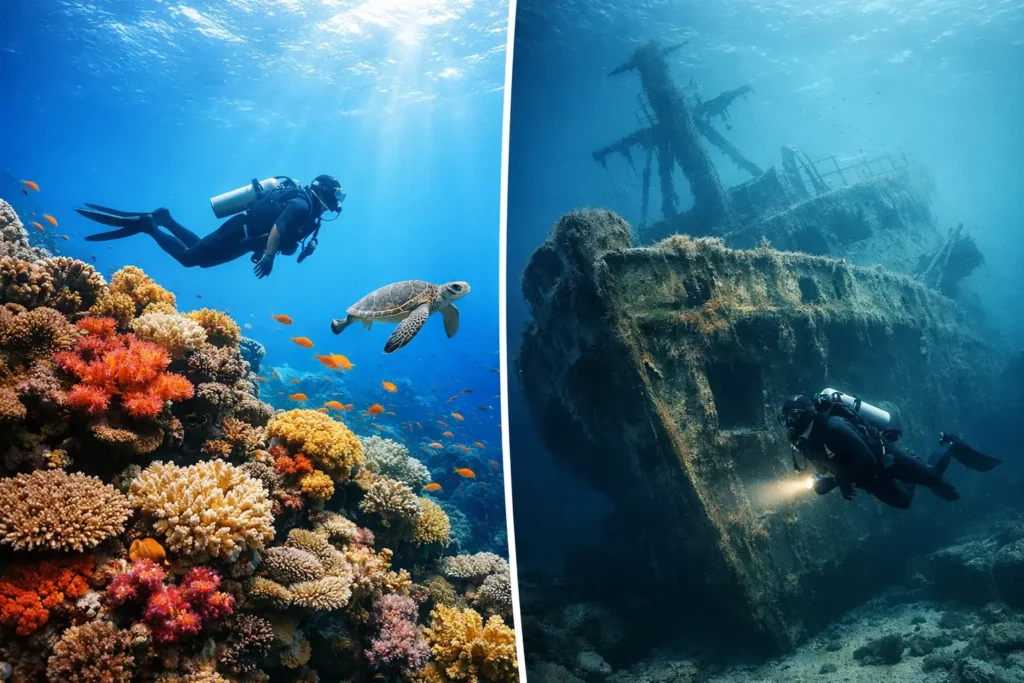
One diver comes up talking about a hawksbill turtle slipping through coral towers. Another cannot stop replaying the moment a shipwreck appeared out of the blue like a ghost with propellers. That is the heart of reef diving versus wreck diving – both are memorable, but they deliver very different kinds of excitement.
If you are planning a dive trip and trying to choose between the two, the right answer is not which one is better on paper. It is which one fits your comfort level, curiosity, and the kind of underwater story you want to bring home. Some divers want color, movement, and easy orientation. Others want structure, history, and the thrill of swimming through a site that feels almost cinematic. Most eventually want both, but your first choice matters.
Reef diving versus wreck diving: what really changes underwater
From the surface, both can look similar. You gear up, descend, equalize, check your buddy, and start exploring. Underwater, though, the mood shifts fast.
A reef feels alive in every direction. Even on a calm, easy dive, there is always something happening – coral formations, schools of fish, rays cruising over sand patches, tiny creatures tucked into crevices, and changing light across the bottom. Reef diving is often more open visually, which can make it feel relaxed and spacious.
A wreck creates a stronger focal point. Instead of following the natural contour of coral and rock, your attention goes straight to the shape of the vessel. You notice the bow, railings, cargo holds, mast sections, and the way marine life has claimed the structure over time. Wrecks often feel dramatic, sometimes mysterious, and occasionally a little intimidating at first glance.
Neither style is automatically harder or better. It depends on the specific site, the conditions that day, and your own experience in the water.
Why reef dives are often the easier starting point
For many beginners, reef diving feels more intuitive. The natural landscape is easier to read, and there is usually less pressure to follow a specific route around a structure. That can make it easier to settle your breathing, work on buoyancy, and enjoy the dive instead of overthinking it.
Reefs also tend to offer more constant visual variety. If you are a newer diver, that matters. You do not need a trained eye to enjoy a reef. Big fan corals, bright tropical fish, sponges, sea stars, and turtles have instant appeal. You can simply move slowly and let the environment come to you.
In places like the Dominican Republic, reef sites can be especially rewarding because warm water and good visibility let new divers stay focused on the experience rather than managing stress. That is a big reason why so many Try Scuba sessions and early certification dives happen on reefs first.
There is also a comfort factor. Reefs usually do not carry the same psychological weight as a shipwreck. Even when the depth is similar, a reef often feels friendlier. For families, couples with mixed experience levels, or travelers who want a beautiful dive without too much intensity, reefs are usually the safer bet.
What wreck diving gives you that reefs do not
Wreck diving has a pull that is hard to explain until you try it. Part of it is scale. Even a modest wreck can feel huge underwater, especially when it rises off the seafloor and comes into view slowly through the blue. Part of it is history. You are not just looking at marine life. You are looking at a manmade structure with a past, now transformed into an artificial reef.
That combination changes the whole dive. You are not wandering. You are investigating.
Fish behavior can be different on wrecks too. Large schools often circle the structure. Predators may patrol around the edges. Moray eels, crabs, and smaller reef species hide in openings and shadows. Soft corals and sponges can cover metal surfaces, creating a strange mix of industry and nature that makes wreck sites especially photogenic.
For certified divers who want something with a little more edge, wrecks often feel more adventurous. You may be paying closer attention to depth, current, and navigation. You may be hovering near openings, peering into compartments, or following your guide around the outside of the structure. That focus is part of the appeal.
Skill level is not just about certification
People often assume reef dives are for beginners and wreck dives are for advanced divers. That is only partly true.
Some wrecks are excellent for newer certified divers because they sit at comfortable recreational depths, have easy conditions, and are explored from the outside only. On the other hand, some reefs can be surprisingly demanding if current picks up, surge increases, or the profile requires stronger air management.
The better question is whether the dive matches your actual comfort in the water. Are you calm on descent? Can you maintain buoyancy without sculling your hands constantly? Do you stay aware of your buddy, depth, and air while still enjoying the surroundings? If yes, your options open up quickly.
Penetration is where wreck diving becomes a very different category. Swimming inside a wreck is not the same as circling around one. That kind of dive requires additional training, proper equipment, and a serious respect for overhead environments. For many vacation divers, an exterior wreck dive provides all the excitement they want without adding unnecessary complexity.
Marine life: abundance versus concentration
If your dream dive is built around marine life, reef diving usually wins on variety. Reefs support a broad ecosystem, so you get a little of everything. Colorful fish, coral formations, sandy channels, cleaning stations, and occasional larger visitors all create that classic Caribbean underwater feel.
Wrecks are often better for concentrated action around a structure. Because the wreck acts as shelter, bait, and habitat, you may find dense clusters of life packed into one area. It can feel busy in a different way. Instead of scanning a broad scene, you study every beam and opening because something may be living there.
Photographers often have strong preferences here. Wide-angle shooters may love the shape and drama of wrecks. Divers who enjoy fish portraits, macro subjects, and vivid natural backgrounds often lean toward reefs. Again, it depends on the site, but your style of seeing underwater makes a difference.
Conditions and comfort matter more than people admit
A lot of divers choose based on image rather than feel. They picture the perfect wreck shot or the classic coral wall, but the better choice often comes down to conditions.
Reefs can be more forgiving when visibility is average because the environment still reads naturally at close range. Wrecks benefit from cleaner water. When visibility is strong, the structure reveals itself from farther away and the sense of scale becomes part of the experience.
Current also changes the equation. Moderate current on a reef can be fun, almost effortless, if the route allows for an easy drift. Around a wreck, current may become more technical because the structure creates pressure points, eddies, and places where finning effort increases fast. For divers who are still building confidence, that detail matters.
Then there is the mental side. Some divers feel instantly at ease on reefs and tense around wrecks, especially if the structure is large or dark. Others find reefs beautiful but prefer the clear purpose of a wreck route. There is no wrong response. The best dive is the one that keeps you engaged without pushing you past your comfort zone.
Which one should you choose on vacation?
If you are brand new, taking a resort course, or getting back in the water after years away, start with a reef. You will usually have an easier, more forgiving introduction and still see plenty. That first good dive sets the tone for the rest of your trip.
If you are certified, comfortable, and craving something more distinctive, a wreck may be exactly what you are looking for. It feels different from the moment you descend, and for many divers it becomes the dive they talk about most afterward.
If you have time for two dives, the smartest move is often one of each. That is where a good local crew makes all the difference. An experienced dive center can look at your certification, recent experience, air consumption, and confidence level, then recommend the right sequence instead of pushing a one-size-fits-all plan. In Bayahibe, that local judgment matters because sea conditions, visibility, and site selection can turn a good day into a great one.
At Sharky’s Crew AKA Diving DR, that is exactly how we approach it – not by asking what sounds coolest online, but by matching each diver to the experience they will genuinely enjoy.
The real answer to reef diving versus wreck diving
Reef diving feels like entering a living landscape. Wreck diving feels like stepping into a story that the sea is still rewriting. One is not a backup option for the other. They simply satisfy different instincts.
Choose the reef if you want color, ease, and that classic tropical underwater feeling. Choose the wreck if you want structure, atmosphere, and a little more adrenaline. If you are lucky enough to do both, you will understand why experienced divers never stop arguing about favorites – and why they keep booking the next dive anyway.
