


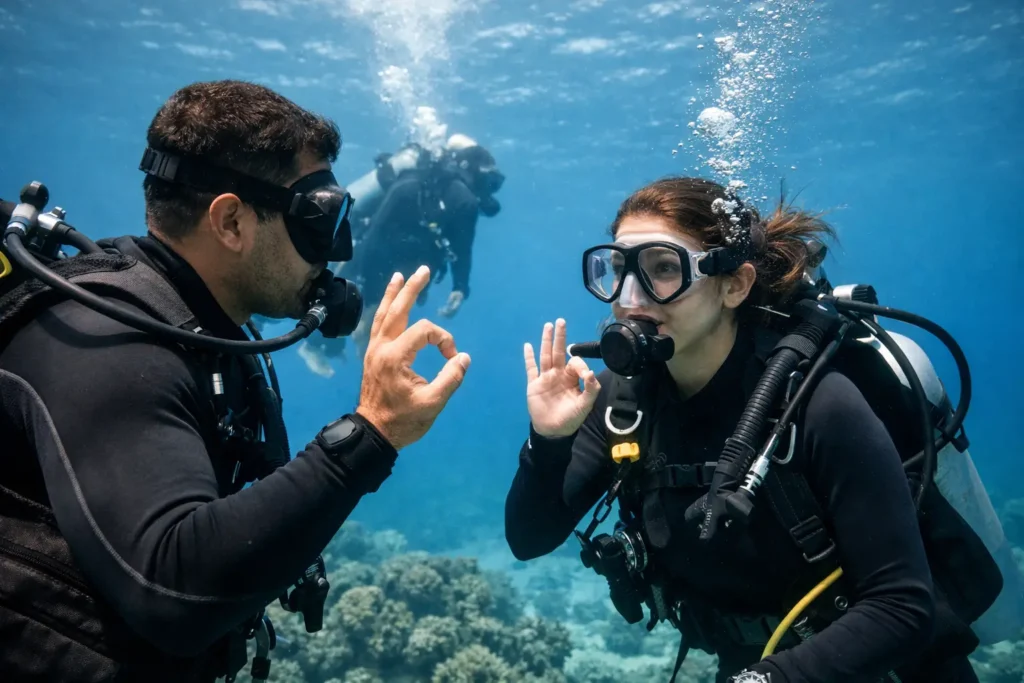
Your first breath underwater is a moment you will remember. The surface becomes quiet, fish move through the reef at eye level, and you realize you are doing something that once seemed reserved for experts. So, is scuba diving safe for beginners? Yes – when the experience is properly supervised, conditions suit a first-time diver, and you take the training seriously.
Scuba is not an activity to rush into blindly. It asks you to learn a few essential skills, communicate clearly, and stay within the limits of your training. The good news is that modern entry-level diving is designed around exactly that. A professional instructor does not simply put a tank on your back and send you down. They build your confidence step by step, beginning in shallow water and progressing only when you are comfortable.
Is Scuba Diving Safe for Beginners in Real Conditions?
The honest answer is that scuba diving has risks, just as driving, boating, and many outdoor activities do. Pressure changes affect the body, equipment must work correctly, and water conditions can change. But those risks are managed through standards, planning, equipment checks, and conservative decisions made before anyone enters the water.
For a beginner, the biggest safety factor is not being naturally brave, athletic, or adventurous. It is choosing the right dive center and instructor. A patient professional will explain what is happening, demonstrate every skill, watch how you respond, and never pressure you to continue if something does not feel right.
In Bayahibe, warm Caribbean water and many sheltered, shallow reef areas can make the first experience especially welcoming. Clear water helps beginners stay oriented and see their instructor easily. Still, good conditions do not replace good supervision. A calm sea is only one part of a safe day.
What Makes a First Dive Safer
A well-run Try Scuba experience or beginner course follows a deliberate rhythm. Before the boat leaves or anyone steps into the water, you should receive a clear briefing on breathing, equalizing your ears, hand signals, and what to do if you feel uncomfortable. You should know that you can stop the experience at any time.
Your instructor should also check the fit of your mask, fins, buoyancy device, weights, and regulator. Equipment that is maintained properly and fitted correctly is far easier to use. A mask that leaks constantly or fins that hurt your feet may not sound serious, but small frustrations can distract a nervous new diver.
Once in the water, the first skills happen in a controlled, shallow setting. You practice breathing from the regulator, clearing water from your mask, recovering the regulator if it comes out of your mouth, and using basic hand signals. These are not tricks to memorize for a test. They are simple responses that show you how capable you are underwater.
A responsible instructor stays close. For a first dive, that means close enough to offer calm guidance immediately, not somewhere ahead taking photos. Small groups and private instruction can make a meaningful difference here, especially for couples, families, or anyone who feels apprehensive about being underwater for the first time.
The Rules That Matter Most
Most beginner safety rules are straightforward, but they matter because they prevent small issues from becoming stressful ones. Breathe continuously and never hold your breath. Ascend slowly with your instructor. Equalize early and often while descending. Stay close to your guide, and speak up with a hand signal the moment your ears hurt, your mask bothers you, or you simply need a pause.
There is no prize for going deeper, staying longer, or pretending you are relaxed when you are not. The best first dive is one that feels controlled from start to finish.
Your Health Matters Before You Book
Not every traveler should scuba dive that day, even if the reef looks perfect. You may need medical clearance before participating if you have certain heart, lung, ear, sinus, neurological, or blood sugar conditions, have recently had surgery, or take medications that could affect your awareness or breathing. Pregnancy is generally a reason to skip scuba diving.
A cold, severe congestion, or an ear infection can also turn an otherwise easy descent into an uncomfortable one. If you cannot equalize your ears, do not force it. A good crew will reschedule, suggest another activity, or help you enjoy the boat day without making you feel as though you missed out.
Be honest on the medical questionnaire. It is not a formality and it is not there to exclude people. It helps your instructor make the safest decision for you. If you have a question about a condition, ask before your trip rather than waiting until you are standing on the dock in a wetsuit.
Is Scuba Diving Safe for Beginners Who Feel Nervous?
Absolutely – nervousness is common, and it does not mean scuba is not for you. Many confident divers began with a racing heart during their first few breaths through a regulator. What matters is whether the team gives you space to settle in.
You do not have to descend the second your face enters the water. Take a minute at the surface. Hold the line or the boat, breathe slowly, and let your body adjust. When you are ready, descend gradually. If you decide you are not ready, stopping is a smart decision, not a failure.
Fear often comes from imagining a problem without knowing what you would do. Instruction replaces that uncertainty with practical actions. Your regulator provides air. Your buoyancy device helps you float at the surface. Your instructor is beside you. You have hand signals to communicate. The underwater world feels much less intimidating when those facts become real through practice.
For particularly anxious first-timers, private or semi-private instruction is often worth considering. It allows the instructor to work at your pace and gives you more time for questions before entering the water. It is a different experience from being hurried through a large group schedule.
How to Choose a Beginner-Friendly Dive Experience
Look beyond the lowest price or the most dramatic photos. Ask whether the operator is affiliated with a recognized training agency such as SSI, how many beginners are assigned to each instructor, where the first skills take place, and what happens if you are uncomfortable in the water.
You should also ask about the day’s conditions. Strong current, rough surface conditions, or a deep site may be appropriate for experienced certified divers but not ideal for a first experience. The right operator adjusts the plan rather than trying to force every guest into the same itinerary.
A beginner-focused crew will be direct about what the experience includes. A Try Scuba session lets you experience diving under close professional supervision, but it is not the same as certification. An SSI Open Water course takes more time and teaches the skills needed to dive with a buddy after certification. Neither option is better for everyone. It depends on whether you want one extraordinary introduction or the foundation for a lifetime of diving.
At Sharky’s Crew, the approach is personal: first-time divers are not treated as a number on a boat manifest. The crew can match the pace, site, and level of attention to the people in the water, whether that means a gentle first reef dive for a couple or a more structured path toward certification.
A Few Things You Can Do Before the Day
You do not need to be an Olympic swimmer to try scuba, but basic comfort in water helps. Get a good night’s sleep, drink water, eat a light meal, and avoid alcohol before diving. Arrive with enough time to listen to the briefing rather than rushing in at the last minute.
Bring your questions, too. Ask how to equalize, what marine life you may see, how deep you will go, and how long you will be underwater. The more clearly you understand the plan, the more you can enjoy the anticipation.
The Caribbean should feel exciting, not intimidating. With the right instructor beside you, a sensible plan, and permission to go at your own pace, that first breath underwater can be the beginning of something far bigger than a vacation memory.
