


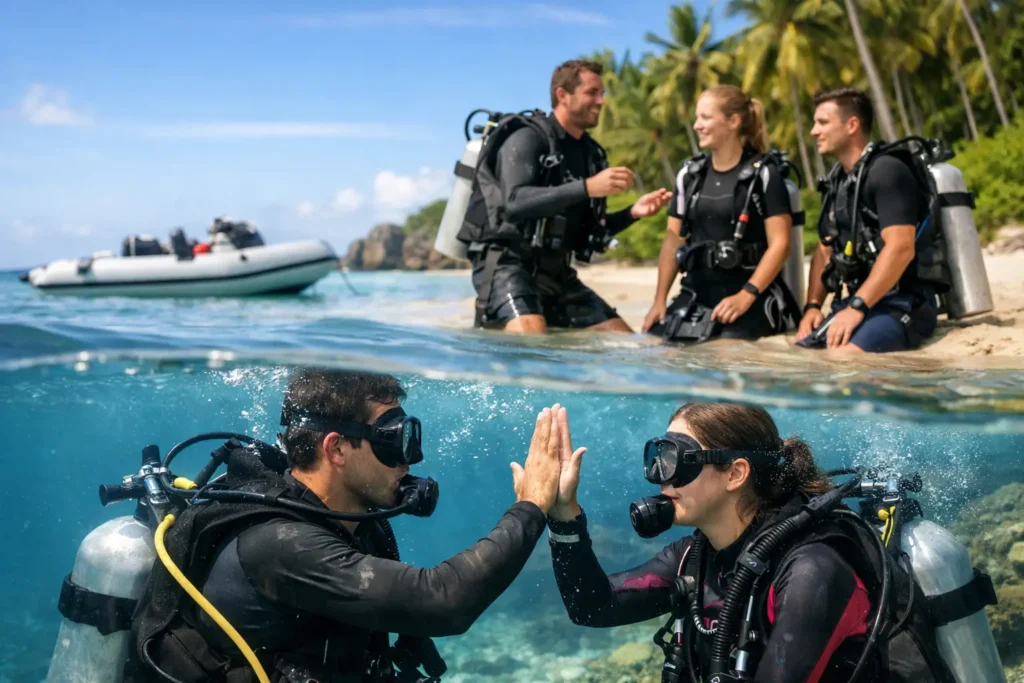
A vacation can give you a beautiful boat ride and a quick look below the surface. An SSI Open Water Course review needs to answer a bigger question: can a few days of training give you the confidence to explore that underwater world independently, safely, and for years after you fly home?
For most first-time divers, the answer is yes – provided you choose a center that treats the course as real skill-building, not a fast track to a certificate. SSI Open Water Diver is the entry-level certification that opens the door to recreational diving around the world. It is also an investment of vacation time, energy, and trust. Here is the honest version of what you receive, what can vary, and when the course makes sense.
What the SSI Open Water Course Actually Covers
SSI Open Water Diver certification teaches the foundational skills needed to dive with a buddy to a maximum depth of 60 feet. You learn how diving equipment works, how pressure affects your body, how to plan a dive, communicate underwater, manage buoyancy, and respond calmly to common issues such as a lost regulator or a low-air situation.
The course combines three parts: digital academic learning, confined-water skill sessions, and open-water training dives. The academic portion lets you work through the theory before arriving or between training sessions. That flexibility is useful on a Caribbean vacation, but it does not remove the need to understand the material. Your instructor should still review key concepts, answer questions, and make sure you can apply the knowledge rather than simply complete screens.
Confined-water sessions are where the essential movements become familiar. You will practice clearing water from your mask, recovering and clearing your regulator, sharing an alternate air source, controlling your ascent, and achieving neutral buoyancy. Then, on open-water dives, you perform those skills in the environment where you will actually use them.
This structure is not glamorous every minute. There can be a little repetition, and a mask-clearing exercise may test your comfort zone. That is the point. A good course creates capable divers, not passengers who happen to be underwater.
SSI Open Water Course Review: The Strong Points
The biggest advantage of SSI is its flexible, app-based learning system. Travelers can begin the theory at home, which leaves more daylight for practical training after arrival. It is a smart option for people who prefer to prepare at their own pace rather than spend a large portion of their trip in a classroom.
SSI also puts real emphasis on comfort and progression. Students should not be pushed through a skill before they understand it. If you need another attempt, more time in shallow water, or a clearer explanation, the right instructor adapts. That matters especially for adults who are strong swimmers but new to breathing underwater, as well as nervous first-timers who want a private or semi-private experience.
The certification itself is widely recognized. Once certified, you can book supervised recreational dives in destinations across the Caribbean and beyond, subject to the local operator’s conditions and the experience required for a specific site. It is not a license to ignore limits or skip a briefing, but it turns scuba from a one-time vacation activity into a lasting travel option.
For guests training in Bayahibe, the setting is a genuine advantage. Warm water reduces the distraction of cold, and Caribbean visibility can make early open-water dives feel far less intimidating. Instead of trying to master buoyancy in gray water and heavy exposure gear, many students begin over bright reef scenery where fish, coral, and clear light provide a memorable reason to stay focused.
Where the Experience Can Fall Short
Not every SSI Open Water course feels the same. SSI provides the training framework, but the quality of your experience depends heavily on the instructor, group size, scheduling, equipment condition, and whether the center is willing to slow down when needed.
A large student group may cost less, but it can mean less individual feedback in the water. Beginners do not all learn at the same speed. One person may settle into breathing from a regulator immediately, while another needs a few extra calm minutes before a mask skill feels manageable. Small groups give an instructor more opportunity to notice small problems before they become frustrating habits.
There is also a difference between a compressed course and a rushed one. It is possible to complete Open Water training efficiently when students arrive prepared, the sea is cooperative, and scheduling is organized. But a center should never sacrifice comfort or safety to fit certification around a boat departure. If someone tells you that questions, extra practice, or a rescheduled session are inconveniences, look elsewhere.
Finally, certification is only the beginning. New divers often leave the course excited but still developing buoyancy, air consumption, and underwater awareness. That is normal. The best next step is usually a relaxed guided dive or two soon after certification, not immediately chasing the deepest or most demanding site available.
How Much Time Should You Reserve?
Plan for at least three days if possible. The exact schedule varies according to the center, your previous preparation, weather, and how quickly you complete each performance requirement. Starting digital learning before your trip can make the days on location more enjoyable, but reserve enough room in your itinerary to avoid pressure.
Do not schedule your final open-water dive immediately before flying. Standard dive safety guidance requires time at the surface before air travel, and your dive center should explain the appropriate interval for your diving profile. A good itinerary places the course early in the vacation, leaving later days open for certified fun dives, a private boat day, or a quiet beach afternoon.
Who Should Take It – and Who Should Wait?
SSI Open Water is a strong choice for travelers who want more than a quick introduction. If you have loved snorkeling, keep thinking about that first Try Scuba experience, or want future trips to include reefs and wrecks, certification offers much more freedom than a single supervised resort dive.
You do not need to be an elite athlete. You do need basic comfort in the water, the ability to meet the required swim and floating assessments, and honest communication about your health and confidence level. If you have a medical condition, recent surgery, respiratory concern, or uncertainty about fitness to dive, address it before training. A medical clearance may be required, and that process exists to protect you.
Waiting can be the better choice if you are extremely anxious about water, short on time, or only interested in seeing what scuba feels like once. A Try Scuba session is often a better first move in those cases. It offers a supervised introduction without the same academic and skill commitment. There is no prize for forcing certification into a schedule that does not suit you.
What to Ask Before You Book
Before choosing a course, ask how many students will be with your instructor and whether private or semi-private training is available. Ask where confined-water skills take place, how open-water dives are selected, what equipment is included, and whether the quoted price covers digital materials, certification processing, and any required marine fees.
It is also worth asking what happens if weather changes, a student needs more practice, or a skill is not completed on the planned day. The answer reveals a lot about the operation. Clear policies and patient instruction are signs of a center that values the diver, not just the schedule.
At Sharky’s Crew AKA Diving DR, that personalized approach is particularly valuable for travelers who want their first certification to feel like a Caribbean experience rather than a production line. The crew knows these waters well, but the priority remains the same on every session: make sure each new diver feels ready before moving forward.
Is SSI Open Water Worth It?
For travelers who want scuba to become part of their life, SSI Open Water is absolutely worth the commitment. You gain practical skills, a globally accepted certification, and a new way to experience places that are invisible from the beach. The course asks for concentration and patience, but it gives back far more than a stamp in a digital logbook.
Choose the center with care, give yourself adequate time, and arrive willing to learn rather than simply collect a card. Your first calm breath over a Caribbean reef can become the moment every future trip starts to look different.
