


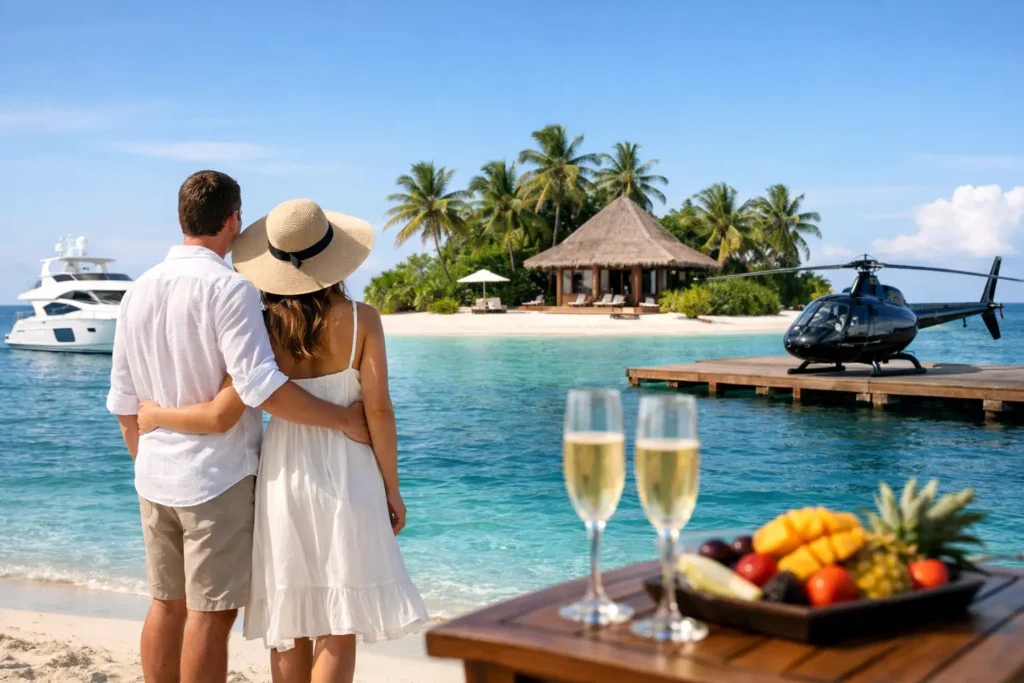
The first sign of a great island day is often what you do not hear: no loudspeaker, no rush to claim a seat, no line of guests waiting for the same beach photo. The future of private island excursions is moving away from one-size-fits-all day trips and toward something far more valuable – time that feels genuinely your own.
For travelers visiting the Dominican Republic, that shift matters. Saona Island remains a Caribbean icon for good reason: bright white sand, shallow turquoise water, palms moving in the trade winds, and the protected beauty of Parque Nacional del Este. But an iconic destination can feel very different depending on how you arrive, when you arrive, and who is guiding the day.
Private Island Excursions Will Be Built Around Time
The old excursion model is designed for volume. Large groups leave on fixed schedules, follow the same route, stop at the same places, and return according to a timetable that has little room for changing weather, a child’s nap, or a couple who would rather stay in the water for another half hour.
Private boating changes the rhythm. Instead of fitting your day into someone else’s plan, the route can respond to your group. A family may want a gentle first swim in calm water before reaching the beach. Friends may want music, snorkeling, and a longer stop at a natural pool. A couple may want the quietest stretch of sand possible and a lunch that does not feel rushed.
That does not mean every minute should be improvised. The best private excursions still have a well-planned foundation: departure windows, weather checks, fuel planning, safe navigation, and a captain who knows which areas are exposed to wind and which are protected. Flexibility works because experienced crews do the operational work behind the scenes.
Early Departures Will Matter More Than Bigger Boats
As travelers become more selective, the real luxury will not be a larger vessel or a louder onboard party. It will be arriving early enough to experience a place before it becomes busy.
A private boat departing from Bayahibe can get out ahead of the main excursion traffic, giving guests a different first impression of Saona’s coastline. The water is often calmer in the morning, the light is softer, and the beach feels less like a scheduled attraction. You are not racing a crowd. You are starting the day at the right pace.
Early travel also gives a captain more choices. If one beach begins filling up, there is time to move. If conditions are especially beautiful at a snorkeling stop, the group can enjoy it without watching the clock. On the Caribbean, timing is not a minor detail. It is often the difference between seeing a destination and feeling connected to it.
The Future of Private Island Excursions Is Local
Technology can help travelers compare boats, read reviews, and reserve a trip quickly. It cannot replace local judgment on the water.
A captain who works these routes week after week knows that the best plan for Saona, Catalina Island, or the Chavon River is never copied blindly from yesterday. Wind direction, sea state, seasonal conditions, marine activity, and the number of boats already heading toward a stop all affect the day. A local crew reads those details before guests ever step aboard.
This is why private excursions will increasingly be chosen for expertise, not just exclusivity. Travelers want to know who is operating the boat, how they handle safety, and whether they can offer honest advice rather than simply promise the same postcard moment in every condition.
At Sharky’s Crew, nearly 20 years on Bayahibe waters shapes the experience in practical ways: knowing when to leave, where to pause, when to choose a calmer route, and how to create a day that feels easy for guests without taking shortcuts on safety. That kind of knowledge is not a luxury add-on. It is the foundation of a great day at sea.
More Personal Does Not Mean Less Responsible
Private travel has a responsibility problem to solve. Smaller groups can reduce the feeling of overcrowding, but a private boat is not automatically a low-impact choice. The future belongs to operators and guests who treat protected coastal environments with care.
In places near Parque Nacional del Este, that means respecting restricted areas, avoiding damage to shallow seagrass and coral, carrying waste back to shore, and choosing stopping points responsibly. It also means resisting the urge to turn every natural setting into a backdrop for high-volume activity.
For guests, responsible travel can be simple. Use reef-safe sun protection where appropriate, avoid standing on coral or touching marine life, and listen when the crew asks everyone to keep distance from sensitive areas. The most memorable encounters with the Caribbean are better when they remain wild.
There is a trade-off here. The most secluded-looking location may not be the right stop on a particular day. Wind, tides, conservation rules, or changing conditions can make another beach or snorkeling site the smarter choice. A trustworthy crew explains the decision clearly and offers an alternative that still feels special. Safety and care for the coast should never be treated as disappointments.
Snorkeling and Diving Will Become Part of the Island Day
The next generation of private excursions will not separate the boat ride, the beach, and the water quite so sharply. More guests want an island day with layers: a quiet cruise, a swim over clear water, a snorkel stop, a beach break, and perhaps an introduction to scuba diving for someone ready to take their first breath underwater.
That demand makes sense. The Dominican Republic’s coastline is not only about sandbars and beach bars. It is also about reef life, wrecks, shallow training areas, and the surprise of looking below the surface and realizing how much of the destination is hidden from the shore.
For mixed groups, this is especially useful. One person may be a certified diver, another may be curious but nervous, and others may simply want to relax in the sun. A private format gives the day room to accommodate different confidence levels. The key is to plan honestly. Diving adds time, equipment, and safety requirements, so it should be organized as a real part of the itinerary rather than squeezed in as an afterthought.
Privacy Will Be Defined by Choice, Not Isolation
When travelers say they want a private island excursion, they do not always mean they want to be alone on an empty island. Sometimes they want to celebrate with family, host a small corporate group, or spend a day with close friends without sharing their boat with strangers.
That is an important distinction. Privacy is having control over the atmosphere. It is choosing the music, the pace, the food, the swimming stops, and the moments worth lingering over. It is being able to ask questions, change plans, and let the crew know what would make the day work better for your group.
For corporate and incentive travel, this will become even more valuable. A well-run private boat day gives a group space to connect without the forced feeling of a standard team activity. It can be celebratory, relaxed, and polished while still feeling like a real Caribbean escape.
What Smart Travelers Will Ask Before Booking
The best question is not simply, “How much is the boat?” Ask what the day actually includes and how it will be run. Who is the captain? How many people will be aboard? What happens if weather changes? Is snorkeling equipment available? Can the route be adjusted for children, non-swimmers, or divers? How early can you depart?
These questions reveal whether an operator is selling a seat or hosting an experience. Price matters, of course, and private boats are not the best fit for every budget or group size. A shared trip can be a fun choice for travelers who enjoy a social party atmosphere. But if your vacation time is limited, the ability to shape one extraordinary day around your people can be worth far more than a standard itinerary.
The Caribbean is at its best when it feels unrushed. Choose the crew that listens, leave before the crowds, and give the day enough room for the moments no schedule could have planned.
