


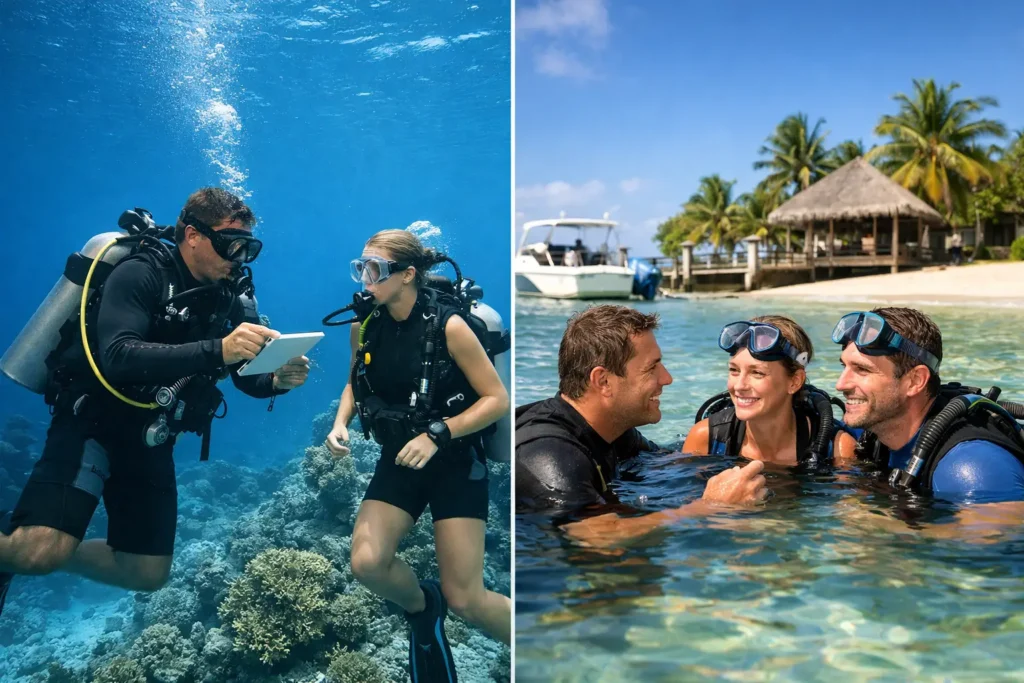
Your first breath underwater changes the shape of a vacation. One minute you are floating in warm Caribbean sunlight; the next, you are weightless over coral, watching schools of fish move through clear blue water. But before that moment, there is a real choice to make: scuba certification vs resort course. One gives you a memorable supervised introduction. The other gives you the skills and credential to keep diving long after your Dominican Republic trip ends.
Neither option is automatically better. The right one depends on how much time you have, how independent you want to be underwater, and whether this is a one-time adventure or the beginning of something bigger.
Scuba Certification vs Resort Course: The Real Difference
A resort course is designed for travelers who want to experience scuba diving without committing to a full certification class. Depending on the dive center and training agency, it may be called a Try Scuba, Discover Scuba, resort dive, or introductory dive. You receive a briefing, learn a few essential skills in shallow water, and then make a closely supervised dive with an instructor or dive professional.
It is a genuine underwater experience, not simply snorkeling with equipment. You will learn how to breathe from a regulator, clear water from your mask, communicate with hand signals, and move comfortably with fins and a buoyancy device. Your instructor stays right beside you throughout the experience. The focus is simple: comfort, safety, and the thrill of seeing the reef from below the surface.
A full SSI Open Water certification course has a different purpose. It teaches the foundation needed to plan and complete dives with a certified buddy, within the limits of your training. The course includes academic learning, practical skill sessions in confined or shallow water, and open-water training dives. Once certified, most new Open Water Divers can dive to a maximum depth of 60 feet with an appropriately qualified buddy or guide, subject to local conditions and dive-center policies.
The most important distinction is what happens after your vacation. A resort course is an introduction, not a certification. A full Open Water course gives you a globally recognized credential that can open the door to future reef dives, wreck dives, liveaboards, and advanced training.
What a Resort Course Is Best For
A resort course is ideal when curiosity is high but your vacation schedule is tight. Maybe you are traveling with a partner who prefers a Saona beach day, a family with different activity levels, or a corporate group looking for a shared first-time experience. You can enjoy the underwater world without spending several days in class.
It is also the right choice for someone who is unsure about scuba. Some guests love the idea of it but want to know how breathing underwater actually feels before committing to certification. That is a sensible approach. A well-run introductory experience lets you test your comfort in calm, controlled conditions with direct professional support.
The trade-off is freedom. After a resort course, you cannot rent gear and head out with a friend, nor can you join standard certified-diver excursions as an independent diver. You will remain under the direct supervision required for an introductory participant.
What Certification Is Best For
Certification suits travelers who already know they want more than one underwater moment. If seeing a sea turtle at 25 feet makes you wonder what lies along a deeper wall, inside a wreck, or on a reef in another country, the course is worth your vacation time.
It is particularly valuable for couples or families who expect to take future beach vacations together. Earning the certification now means less time learning later, and more choices wherever you travel. It also creates confidence. Rather than relying on an instructor to manage every detail, you learn to check equipment, control buoyancy, handle common issues, and make sound decisions with your buddy.
Certification does require more focus. You need to complete the learning, practice skills until they are comfortable, and allow enough time for the required open-water dives. It is active, rewarding training – not a passive tour. Guests who arrive ready to learn often find that the course becomes one of the most satisfying parts of the trip.
Time, Vacation Plans, and the Water You Want to See
For many guests, time decides the question. A resort course can often fit into one day, leaving room for beach time, a private boat excursion, or a relaxed dinner in Bayahibe. A full certification usually takes multiple days, although digital learning completed before arrival can reduce the time spent on vacation doing coursework.
If your trip is only three or four days long, consider your priorities honestly. A resort course may give you the experience you want without turning the whole itinerary into a schedule. On a longer stay, certification is easier to enjoy at a comfortable pace. You can learn the skills, rest between sessions, and still reserve time for the rest of the Caribbean.
Your departure flight matters, too. Divers should allow an appropriate surface interval before flying after scuba diving. Your dive professional can advise based on your actual schedule and number of dives, but it is smart to plan diving earlier in the trip rather than saving it for your final afternoon.
Safety Is Not a Smaller Version of Training
A resort course should never feel rushed simply because it is shorter. The best introductory programs begin with a clear conversation about medical fitness, comfort in the water, and expectations. You do not need to be an Olympic swimmer, but you should be able to stay calm in the water and be honest about any anxiety, ear-pressure concerns, medications, or health conditions.
During the experience, small groups make a meaningful difference. An instructor can notice whether you are breathing quickly, struggling with a mask, or simply needing an extra minute to settle in. That personal attention is why the quality of the operation matters as much as the name of the program.
Certification adds more skills because it prepares you for greater independence. You practice responding to problems before they become stressful: recovering a regulator, sharing air, managing buoyancy, and making a controlled ascent. These are not obstacles placed between you and the fun. They are the reason certified diving can feel so calm and freeing once you are underwater.
How to Choose the Right First Experience
Start with one question: what do you want scuba to be in your life after this trip?
If the answer is, “I want to see the reef once and decide whether I like it,” choose a resort course. You will get the essential first breath underwater, with close supervision and no pressure to turn your vacation into a full training program.
If the answer is, “I can already picture myself diving again,” choose certification. The course asks more from you, but it gives much more back: skills, confidence, and the ability to keep exploring.
If you are traveling as a couple and one person is ready for certification while the other is uncertain, there is no need to force the same path. One guest can begin a full course while the other enjoys an introductory experience or spends the day above water. A thoughtful schedule makes room for both.
Families should also consider age, attention span, and confidence level rather than choosing based on enthusiasm alone. First-time divers often surprise themselves, but the goal is never to push through discomfort. The goal is to leave the water feeling capable, cared for, and excited to return.
Why Bayahibe Works So Well for First-Time Divers
Bayahibe offers the conditions beginners hope for: warm water, colorful reefs, and many sites with calm, accessible entry profiles. Clear conditions can make a major difference on a first dive. When you can easily see your instructor, the bottom, and the fish around you, it is easier to relax and focus on the skills that matter.
At Sharky’s Crew, the experience is built around small or private groups, so the day can move at your pace. A guest who is ready to descend after a few minutes gets support. A guest who needs more time to adjust gets that, too. With nearly 20 years on these local waters, the crew knows that a great first dive is not measured by depth. It is measured by the smile that appears when you surface.
Choose the course that fits the vacation you have now, while leaving room for the adventures you may want next. Whether your first dive becomes a treasured single memory or the first page of a lifelong logbook, it deserves to begin with patient guidance, good conditions, and a crew that wants you to enjoy every breath.
